The Brazilian Trademark and Patent Office ( INPI ) has released its 2025 rankings of intellectual property filings, covering patents and trademarks, and segmented by resident and non-resident applicants. Beyond the numbers, the data reveals where innovation is being produced, who is investing in brand protection in Brazil, and how filing strategies are evolving. For companies operating in the country, understanding these trends is essential to benchmarking their own IP positioning and identifying competitive risks.
Patents
Non-resident applicants
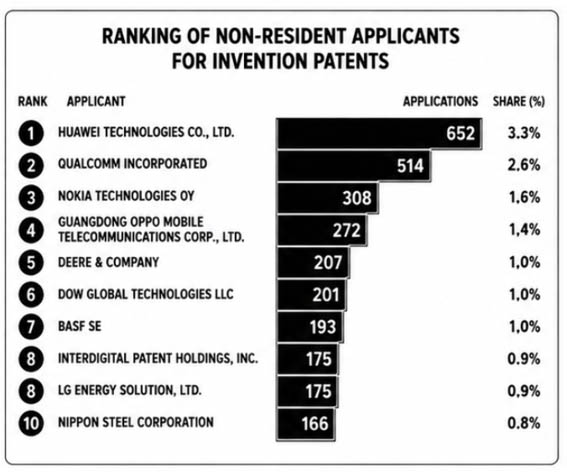
Huawei topped the non-resident patent ranking in 2025 with 652 filings (3.3%), surpassing Qualcomm (514 filings / 2.6%) and Nokia (308 filings / 1.6%). Together, the top 50 non-resident applicants filed 6,183 patents.
Geographically, the U.S. accounts for 30% of companies in the ranking, followed by China at 20%. South Korea (9%) and Japan (7%) round out the Asian presence, while Germany, the Netherlands, Sweden, and Switzerland each represent 6% of the European contingent. Year-over-year, China gained ground at the expense of the U.S., and South Korea overtook Japan.
The dominant sectors are Electronics and IT (27.8%), Chemicals (14.8%), and Pharmaceuticals (11.1%).
Resident applicants
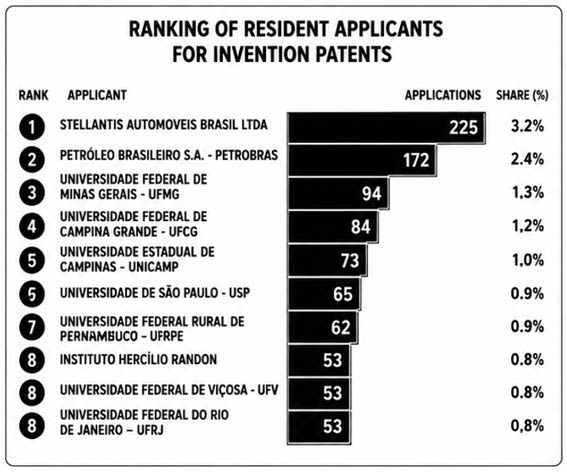
The domestic patent ranking shows strong continuity: six of the top applicants in 2025 were already in the 2024 top 10. Stellantis Automóveis Brasil leads with 225 filings, followed by Petrobras (172) and Universidade Federal de Minas Gerais UFMG (94). Seven of the top 10 are universities or research institutes, a consistent feature of Brazil's innovation landscape that reflects the central role of public research in domestic patent activity.
The top 51 resident applicants collectively filed 1,957 patents, with 70% coming from public entities (universities and research institutes). The leading sectors are automotive, oil and gas, and public research.
Petrobras stands out beyond its filing volume: the company was involved in 49 co-filed patents, functioning as a collaborative hub connecting major innovation centers across the country.
Trademarks
Non-resident applicants
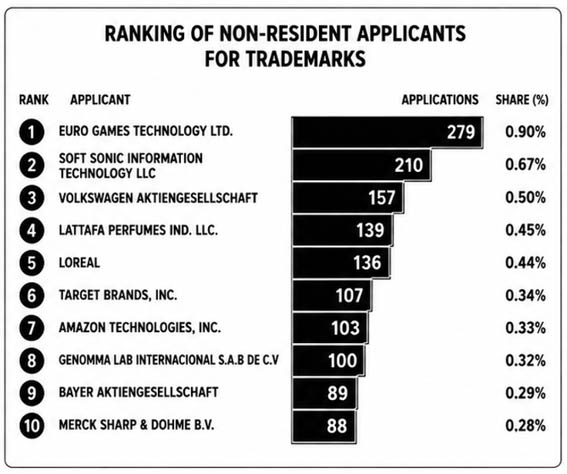
Foreign participation in trademarks is lower than in patents, accounting for 10.9% of filings, with 3,399 registrations. The ranking is geographically broader, with 20 countries represented. The U.S. leads (29.4%), followed by South Korea (7.8%). The top three non-resident applicants are Euro Games Technology (279), Soft Sonic Information Technology (210), and Volkswagen (157).
Key sectors include Electronics and IT (13.7%), Pharmaceuticals (10%), and IT Services (9.8%).
Resident applicants
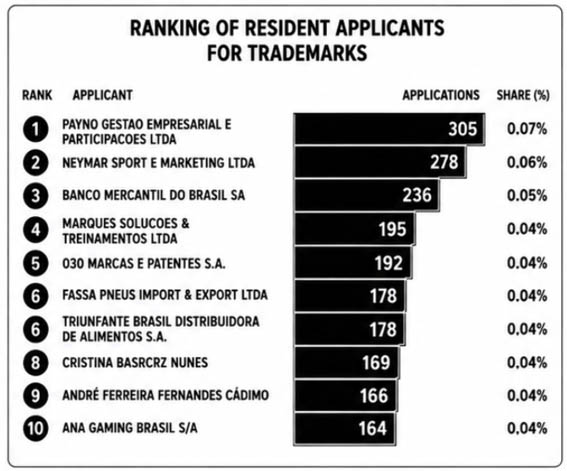
Domestic trademark filings paint a different picture from patents: the ranking is more diverse, service-sector-driven, and reflects a broadening understanding of what constitutes a protectable brand asset. One notable trend is the growing presence of digital influencers and public figures, who are increasingly adopting structured trademark protection strategies alongside traditional corporate applicants.
The leading sectors include trade and retail, healthcare, real estate, financial services, and education. The top applicants are Payno Gestão Empresarial (305), Neymar Sport & Marketing (278), and Banco Mercantil do Brasil (236).
The rankings highlight a dual dynamic in Brazil’s IP landscape. In patents, global tech companies dominate, with growing influence from Asia, while domestically, universities and public institutions lead innovation efforts. In trademarks, the landscape is more diverse and service-driven, with companies, entrepreneurs, and public figures actively investing in brand protection. Overall, the data points to a more mature and strategic use of intellectual property in Brazil, both as a driver of innovation and a tool for market positioning.
Monitoring who is filing, in which sectors, and through what collaborative arrangements is no longer optional, but it is a fundamental part of managing risk and identifying opportunities in the Brazilian market.
Source: